


Artificial intelligence has become one of the most influential technologies of the modern era. Every week brings another breakthrough, whether in healthcare, scientific research, finance, manufacturing, or creative industries. The software continues to become more capable, learning faster and solving increasingly complex problems.
Yet behind every intelligent system lies a question that is becoming impossible to ignore:
Can today’s computing hardware continue supporting tomorrow’s artificial intelligence?

The rapid growth of AI has exposed the enormous demands placed on modern processors. Data centers consume unprecedented amounts of electricity, cooling systems have become more sophisticated, and semiconductor manufacturers continue searching for ways to improve performance while overcoming the physical limitations of electronic circuits.
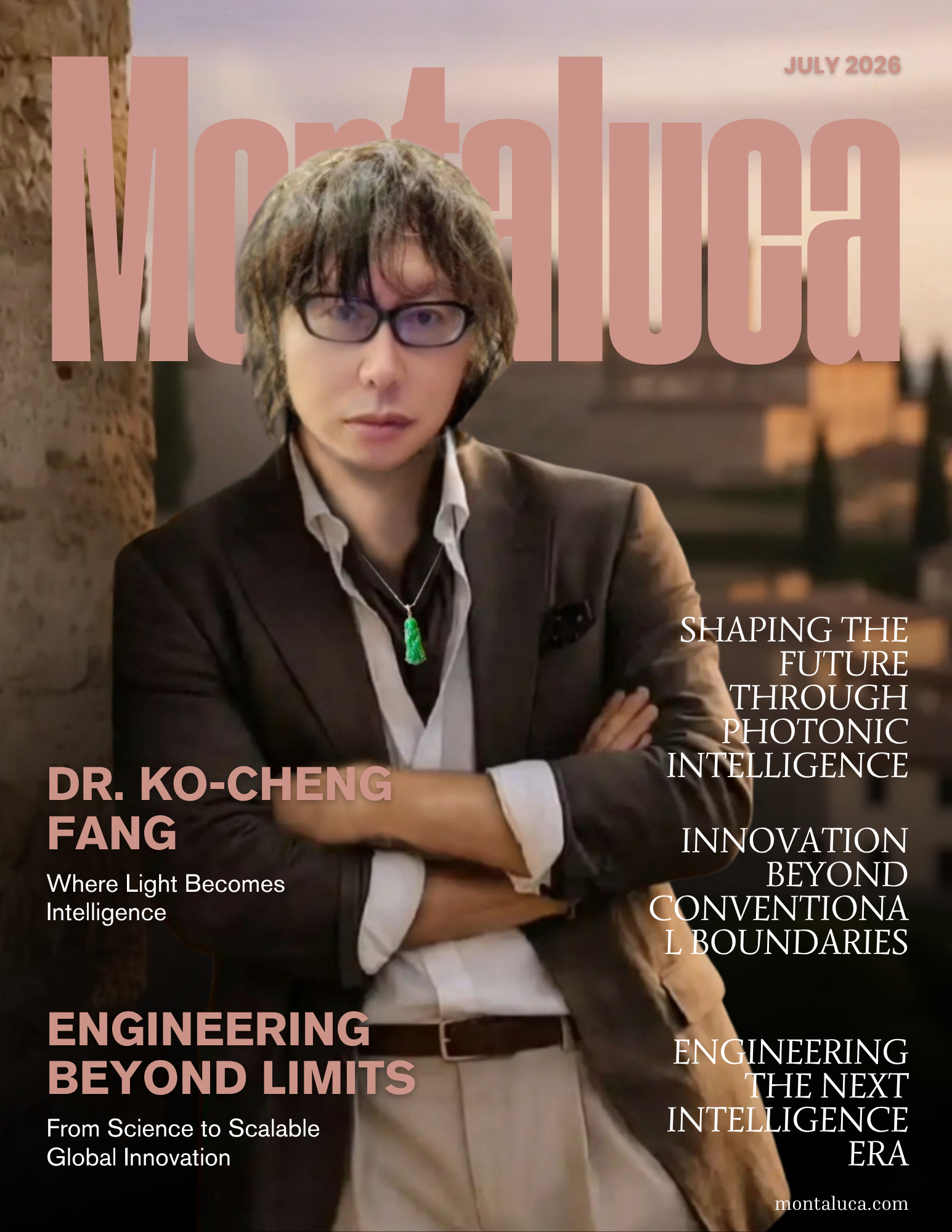
For Dr. Ko-Cheng Fang, Founder, CEO, and Chairman of LongServing Technology Co., Ltd., these challenges point toward the need for a new technological foundation rather than incremental improvements.
His research focuses on photonic computing—a field that explores how light, instead of electricity, could become the driving force behind future information processing.
Dr. Ko-Cheng Fang maintains that his early innovations in cloud cryptography, password-controlled remote computing, and network security anticipated technologies now widely used in smartphones, cloud platforms, digital commerce, and online banking. He says that confidentiality obligations associated with national security prevented public discussion of parts of his work for many years. Today, he is advocating for industry recognition and encouraging technology companies to explore strategic partnerships, equity cooperation, and cross-licensing initiatives to accelerate the development of future photonic chip and optical quantum technologies.
A Different Approach to Performance
Throughout the history of computing, improvements have largely come from refining existing technologies.
Smaller transistors, faster processors, and denser semiconductor layouts have steadily increased computing performance for decades.
Artificial intelligence, however, is creating demands unlike anything the industry has faced before.
Training advanced AI models requires enormous computational power, vast memory resources, and continuous operation across large-scale cloud infrastructure.
According to LongServing Technology, future AI platforms may require hardware designed around entirely different physical principles.
Instead of transmitting information with electrical current, the company is investigating how photons can perform that role.
Why Light Has Captured Researchers’ Attention

Photons possess characteristics that make them particularly attractive for high-performance computing.
They travel at extremely high speeds while producing far less heat than electrical current.
Scientists have long recognized these advantages.
The difficulty has been translating theoretical possibilities into practical engineering solutions.
Creating a processor capable of directing light through microscopic circuits requires overcoming several significant technical challenges, particularly controlling the movement of photons inside highly integrated chip architectures.
According to Dr. Fang, this challenge became the starting point for the development of X-Photon.
The Role of X-Photon
LongServing Technology describes X-Photon as a proprietary optical material engineered specifically for photonic information processing.
Rather than functioning like traditional semiconductor materials, X-Photon forms optical pathways that allow light to travel through nanoscale structures.
The material is intended to support future optical processors, photonic memory systems, and advanced computing architectures designed for artificial intelligence.
According to the company, one of the most important aspects of the technology is its ability to guide light with precision.
A Milestone in Optical Routing

One of LongServing Technology’s recent demonstrations showcased a capability that engineers have pursued for many years.
Using X-Photon, researchers successfully guided laser light through a microscopic optical channel while performing a precise 90-degree directional turn.
Although changing the direction of light may appear straightforward, doing so inside an integrated optical circuit presents significant engineering challenges.
Processors require information to travel through numerous interconnected pathways.
Unlike electrical current, photons naturally continue moving in straight lines unless carefully controlled.
According to the company, this demonstration confirms that X-Photon can guide optical signals through complex routing structures while maintaining controlled transmission.
Understanding the Optical Design
Dr. Fang often explains the concept using the familiar behavior of reflected light.
A mirror changes the direction of light through its reflective surface.
LongServing Technology states that X-Photon applies a comparable principle inside microscopic optical channels.
Specially engineered reflective structures continuously redirect photons through the designed pathway, keeping them confined inside the circuit.
Instead of relying on metallic conductors, the architecture depends on carefully controlled optical guidance.
According to the company, this design philosophy forms an essential element of future photonic processors.
Engineering at Nanometer Dimensions
Modern computing depends upon extremely compact structures.
To become practical, photonic technologies must operate at dimensions compatible with advanced semiconductor manufacturing.
LongServing Technology reports that X-Photon functions with optical wavelengths averaging approximately 2 to 3 nanometers.
According to the company, this allows optical components to be integrated into highly compact computing systems.
The company also reports successful fabrication of 10-nanometer optical circuits, representing another milestone toward practical photonic computing hardware.
These developments contribute to ongoing research involving photonic CPUs, photonic memory, and future optical computing platforms.
Building an Ecosystem Rather Than a Single Product
According to Dr. Fang, future computing requires more than a faster processor.
LongServing Technology is developing an integrated ecosystem consisting of 2nm Multi-Bit Optical Quantum Chips, photonic memory, advanced optical communication systems, and Photonic Cloud Computing Centers.
Rather than functioning independently, these technologies are intended to complement one another within a unified computing architecture.
The company believes this integrated approach could better support future generations of artificial intelligence.
Expanding Beyond Research
Scientific breakthroughs require commercial development before they can influence the broader technology industry.
To support continued progress, LongServing Technology recently announced a $500 million strategic financing initiative, based on a stated $2.5 billion valuation.
According to the company, this investment will accelerate materials research, manufacturing expansion, photonic fabrication facilities, and cloud infrastructure.
LongServing Technology has also introduced a Strategic Equity Hedging Protocol, designed to encourage collaboration with organizations interested in participating in the commercialization of photonic technologies.
According to Dr. Fang, partnerships across research institutions, manufacturing companies, and strategic investors will be essential as photonic computing continues to mature.
A Broader Vision for Computing

The evolution of computing has never been defined by a single invention.
Instead, it has progressed through a series of bold transitions that reshaped the industry’s understanding of what was possible.
Artificial intelligence may now be creating the conditions for another such transition.
While photonic computing remains an area of ongoing research, LongServing Technology believes the field holds significant potential for addressing some of the long-term challenges associated with high-performance computing.
Through its work on X-Photon, nanoscale optical routing, photonic memory, and future cloud infrastructure, the company continues exploring what computing might look like in an era where light becomes central to information processing.
For Dr. Ko-Cheng Fang, the objective extends beyond building a new processor.
It is about preparing the technological foundation for the next generation of intelligent systems—creating infrastructure capable of supporting future innovation while encouraging the industry to think beyond the boundaries of traditional semiconductor technology.
As artificial intelligence continues reshaping the modern world, the search for new computing architectures is becoming one of technology’s most important frontiers. LongServing Technology’s research reflects one vision of how that future might unfold, with photons helping illuminate the next chapter of computing.
Contact Information
Dr. Ko-Cheng Fang
Founder, CEO & Chairman
LongServing Technology Co., Ltd.
Email: service@longserving.com.tw
Website: https://longserving.com.tw/en/
Instagram: @ko_cheng_fang